


Prime Day by the Numbers: What Slickdeals Data Reveals About the Big Shopping Event
Amazon Prime Day is one of the most anticipated shopping events of the year, and Slickdeals sees that play out in real time across our community of deal-seeking shoppers. With Prime Day 2026 on the horizon, we're sharing our top findings from last year's event so brands and retailers can go in with a clear picture of what drives results and where the biggest opportunities are hiding.
What to Know Going Into Prime Day 2026
In 2025, Prime Day drove a 152% increase in orders, 278% increase in GMV, and 73% increase in outclicks compared to our baseline daily averages, making it one of the highest-intent, highest-traffic windows available anywhere on our platform.
Based on our analysis of the 2025 event, here are the five things that matter most:
- Start early. Engagement rises meaningfully in the week before Prime Day. Deals need to be live before the event begins.
- Extend beyond the event. The post-Prime Day halo is real — votes and comments stay elevated for at least a week after. Campaigns that run through this period capture more of the opportunity.
- Look beyond the obvious categories. Home and Tech lead in volume, but Grocery punches well above its weight in votes and orders. Clothing & Accessories shows strong demand against relatively limited supply.
- Recalibrate your pricing for Prime Day conditions. Standard discounting thresholds don't hold during the event. Deeper discounting, stronger deal quality, and smart timing are what drive Frontpage placement and the outclick volume that follows.
- Be prepared. With deal velocity accelerating during Prime Day, brands that arrive ready to go capture more momentum.
Let's take a look at the the data behind each of these takeaways.
Engagement Builds Before the Event and Lingers After
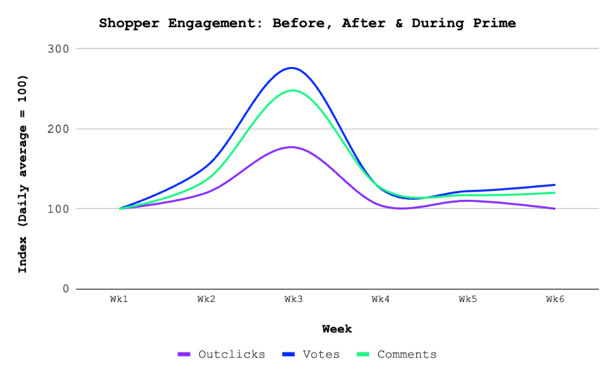
One of the most strategically important findings from our analysis is that Prime Day is not just a four-day event for shoppers on Slickdeals. It is closer to a three-week window of heightened activity.
In the week leading up to Prime Day 2025, votes on deals were already up 47% compared to the prior week. Comments and outclicks were also climbing. Shoppers were actively engaging with deals before the event officially started.
During Prime Day itself, engagement reached its peak: votes spiked to 2.7x the baseline, outclicks hit 1.7x normal levels, deal threads increased 2.6x, and comments were 2.4x the average.
Engagement did not fall off sharply when the event ended. In the week following Prime Day, votes remained 20% above baseline as well as comments (+22%).
The implication is clear: brands that show up only during the core event window are leaving opportunity on the table. The brands best positioned to win Prime Day are those that seed deals early and extend their campaigns into the following week.
Category Insights: Where Volume and Demand Don’t Always Align
When looking at which categories generated the most deal threads, Home & Home Improvement led the way, followed by Tech & Electronics and Computers.
But the more interesting story is where shopper interest outpaced deal supply.
Clothing & Accessories had fewer deals posted than several other top categories, yet it ranked third in total outclicks. Shopper demand for clothing deals was strong, but the supply of those deals was relatively limited.
Grocery tells a similar story from a different angle. It ranked fourth in thread volume but second in total votes, the community’s most direct signal of enthusiasm. That gap between deal supply and shopper response suggests real opportunity for brands in categories where intent is running ahead of available offers.
When it comes to total orders, Home & Home Improvement led, followed closely by Tech & Electronics and Grocery, with Gift Cards, Snacks & Chips, Kids Toys, and Headphones & Earbuds rounding out the top subcategories, a reminder that Prime Day spend runs far broader than big-ticket electronics.
Pricing Strategy: How Much of a Discount Is Enough?
One of the most useful findings from our data involves how discount depth interacts with Frontpage performance and how that relationship changes during Prime Day.
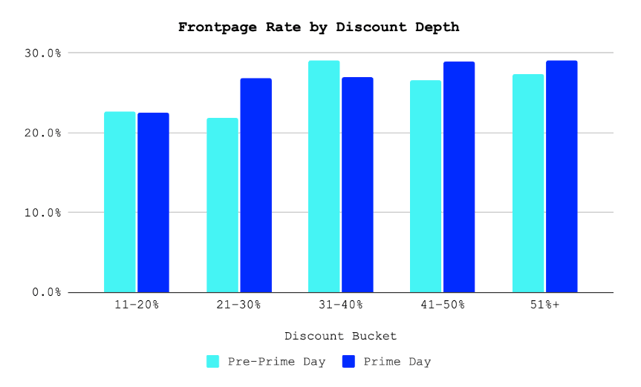
On Slickdeals, the Frontpage is the highest-visibility page onsite. Deals that reach it see dramatically higher outclicks. During a normal period, deals with stronger discounts generally earn higher Frontpage rates, a staircase pattern where 31–40% off outperforms 11–20% off, and so on.
During Prime Day, that staircase collapses.
With 2.6x more deals competing for Frontpage real estate, the threshold rises across the board. A 21% discount competes for the same spot as a 51% discount. The bar has shifted for everyone, which means a brand’s standard pricing strategy, one that performs reliably during the rest of the year, will not produce the same results during Prime Day.
Speed Matters: Deal Velocity During Prime Day
One final dynamic worth understanding is how quickly deals move through Slickdeals during Prime Day. With thread volume up 2.6x versus baseline, the platform is significantly busier and the deal curation process accelerates accordingly.
The average time for a deal to reach the Frontpage during Prime Day was 11.1 hours, compared to 14.1 hours during the baseline period. Deals also reached the Popular forum faster, averaging 5.7 hours versus 6.3 hours normally.
For brands, this means preparation is not optional. If deals are not live and optimized before Prime Day begins, the competition window has already opened. Brands that are ready on day one are in a materially stronger position than those still finalizing offers when the event starts.
About Slickdeals
Slickdeals is the largest crowdsourced deals platform in the United States, with a community of millions of shoppers who share, vote on, and discuss deals across thousands of brands and retailers. Interested in working with us? Connect with us here.
Data & Methodology
All data sourced from Slickdeals internal analytics. Baseline period defined as June 23–30, 2025 (daily averages). Prime Day event period defined as July 8–11, 2025. Pre-Prime Day period (used for discount depth analysis) defined as May 9–July 7, 2025. Shopper engagement timeline covers June 23–July 31, 2025. Category, subcategory, and deal-level rankings reflect activity during the Prime Day event period only. Trending search terms reflect on-site search volume during July 8–11, 2025, excluding keywords that receive consistently high traffic year-round.